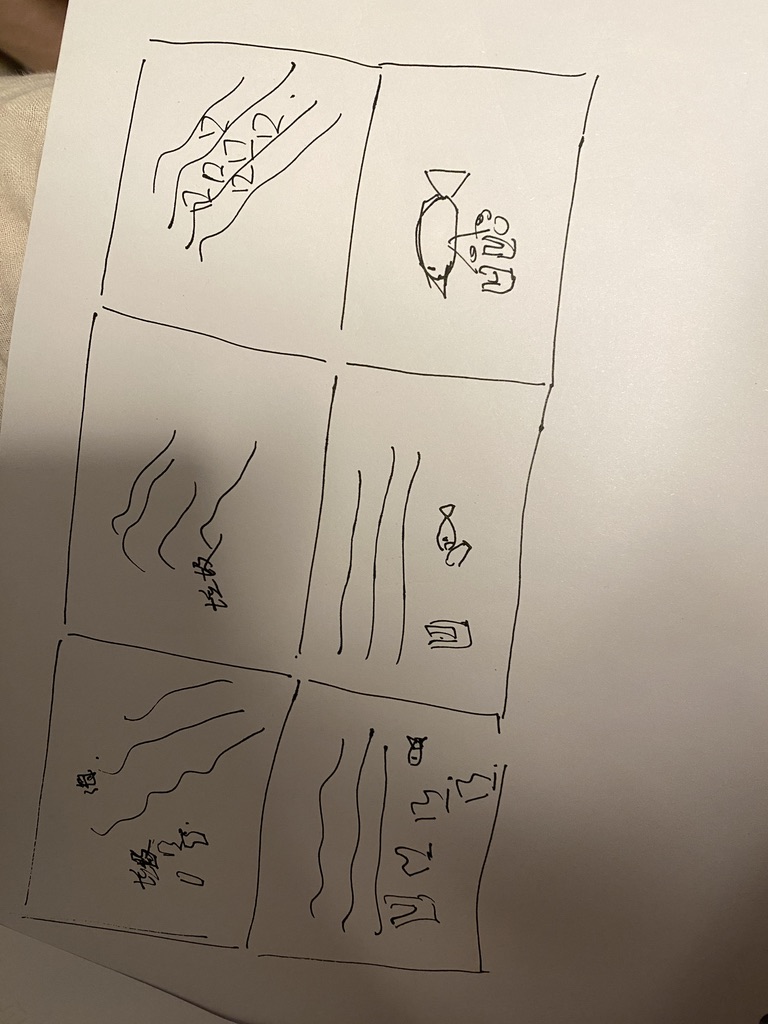
The first panel of my story is because people casually throw garbage everywhere leading to the beach are garbage no one pick up and then there is a tidal wave rushed to a big wave of garbage rolled into the sea, and then the garbage are sunk to the bottom of the sea, the seawater are polluted, and then the next shot is a small fish swam over, I do not know if this is not food to eat the food to the misuse of food, and the results of the fish found that the belly has been loaded with garbage, I’m this! I just want to express that because people are not aware of environmental protection, resulting in the ocean is polluted, pollutants will enter the fish body leading to death, marine pollution will also lead to the deterioration of the water quality, making the living environment of fish worse. Aquatic plants and plankton are affected by pollution, which interrupts the food chain of fish, reduces the supply of bait, and ultimately affects the survival and reproduction of fish. Like industrial wastewater, nuclear pollution is a direct source of marine pollution through rivers, outfalls or direct dumping into the sea, and there is also the impact of plastics on the oceans, with 8 million tons of plastics annually. 8 million tons of plastic enter the ocean every year. There is also the impact of plastic on the oceans, with 8 million tons of plastic entering the oceans every year. That is the equivalent of a truckload being dumped into the sea every minute of the day. From there, it begins a long and destructive journey. “Plastic that enters the ocean can be carried far by ocean currents to reach all parts of the world, including remote Antarctica and the deepest part of the planet, the Mariana Trench,” said Winnie Lau, senior officer for ocean prevention at the Pew Charitable Trusts. Plastic Movement. According to data released by the United Nations humans consume about 1 million plastic bottles per minute and use as many as 5 trillion plastic bags per year; more than 400 million tons of plastic are produced globally each year, 2/3 of which are short-lived, single-use plastics; more than 200 million tons of plastic waste is produced/year, of which less than 1/10 is recycled; and up to 19 million The amount of waste plastic flowing into lakes, rivers and oceans is as high as 19 million -23 million tons/year. So the harm of plastic pollution on the environment is great, so I want to make people resonate and pay attention through the form of animated short film, let people recognize and participate in solving the problem of plastic pollution, in order to influence the market and inspire the change of consumption and production behaviors, and reduce the use of non-essential plastic products. Then I think that the protection of the ocean is a matter related to each person, because when human beings eat seafood, those polluted fish are eaten also produce certain harm to the human body, we must work together to strengthen the protection of the marine awareness, to take targeted measures to reduce pollution, in order to ensure the stability of the marine ecosystem and the sustainable use of the marine ecosystem.
Emma Bryce is a freelance journalist who covers stories focused on the environment, conservation and climate change. [online] Available at:https://chinadialogueocean.net/zh/3/77454/[Accessed 25/01/24]